



What Should a Sales Proposal Include? A Practical Guide from the Perspective of Post-Send Data

You sent the proposal. The client opened it. Sellizer shows they spent 6 minutes, came back twice, sat longest on page 4.
Now what?
If your proposal is a dense PDF where everything - from company description to pricing - runs in one continuous block, this data tells you one thing: the client was there. That's it. No hint of what stopped them, what they skipped, what to react to.
Most articles about what a sales proposal should include end with a list of elements. We'll go one step further - we'll show not just what a good proposal should consist of, but also what you can extract from each part in the data after sending. Because a sales proposal is two documents at once. The first one is meant to convince the client to buy. The second one - to teach you about them with every subsequent send.
Why proposal structure changes what you see in the data
The rule is simple: Sellizer (or any sales proposal tracking tool) only sees what you've shown it. If you fit your entire proposal on three pages, you'll see activity on three pages in the data. If you break it into intentional sections - intro, problem, solution, pricing with separate packages, references, next steps - you see exactly which part the client stopped on, which they returned to, which they skipped.
That's the difference between "the client read the proposal" and "the client spent 4 minutes on the scope of services and skimmed the pricing in 8 seconds". The first piece of information doesn't let you do anything concrete. The second one sets up your entire next conversation.
A well-structured proposal is the foundation of all post-send analytics. Without it, your tool will only show you whether the client opened the document. With it - you see the full palette of behaviors that actually tell you something about them.
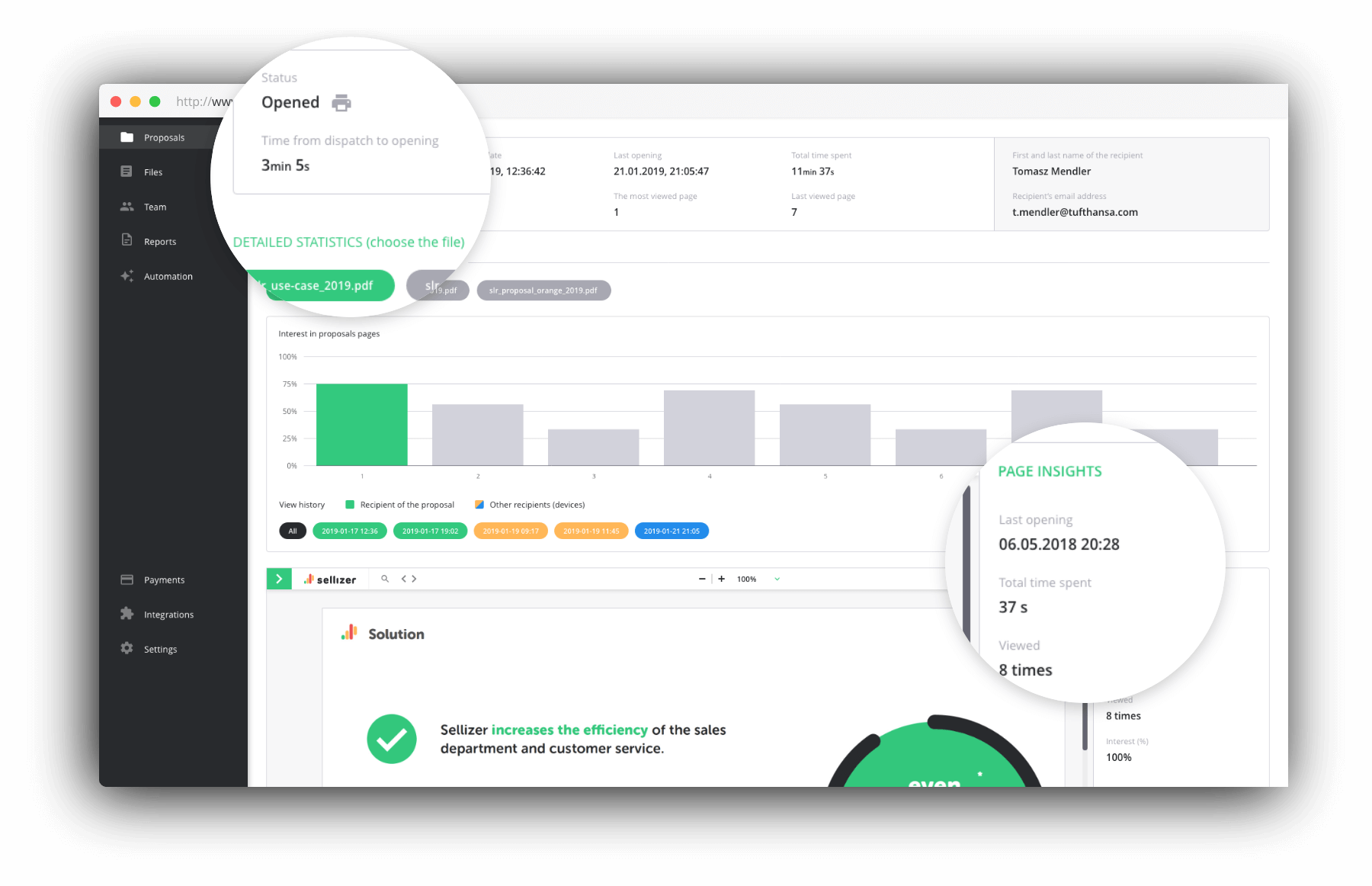
Proposal stats view in Sellizer - client activity broken down by individual proposal pages.
Below we go through all the elements a strong sales proposal should include. For each one we show what its role is, what the post-send data tells you about it, and what move is worth making in response.
Title page and introduction
In a few seconds, it has to show the client this document is for them, not a template sent to everyone.
The title needs to say what the proposal is about - "Proposal for implementing System X for Company Y" works, "Sales Proposal" doesn't. Below the title, one sentence referencing your conversation, ideally with a date and a reference to what the client said themselves. The rest - contact details for both sides, date, validity period - is formality that you don't skip, but that doesn't sell anything. What to skip instead: "we're pleased to present", "we respectfully inform you" and similar phrasings that kill the first impression before the client even starts reading.
In the data, this page tells you about the client's state of knowledge. A few seconds and they move on - they know the context, going straight to the specifics. Over a minute - either they're trying to remember what the call was about, or they're stuck in an overly formal intro. The practical consequence is simple: long time on the intro and short on the solution means the first 5 minutes of the call are worth spending on revisiting the context before you dive into substance. The client skimmed the intro and sat long on the solution - skip the small talk, go straight to concrete details.
Diagnosis of the client's problem
Shows the client you were listening.
This is where 90% of proposals fail in one specific move: they summarize the client's problem in their own words instead of citing the client's. If on the call they said "we're losing 30% of leads at the proposal stage", that's exactly how it should appear in the proposal. Not "challenges occur in the proposal process". Not "we observe a drop in conversion in the middle stage of the funnel". Their numbers, their vocabulary - only then does the client read and recognize themselves, instead of scanning a generic description of their problem.
A long time on the diagnosis is a strong signal that the client recognizes themselves and you've nailed the brief. Short time tells you one of two things. First: the problem is so obvious to them they don't need to read your description - the client knows their pain and moves on. Second: you didn't quite nail the diagnosis and the client slid past with less trust in the rest. The second scenario is worth defusing in the call before you start presenting the solution. One question is enough: "Just checking I understand the priorities right - is this still your number one, or has something changed in the meantime?" It stops the conversation before you dive into the presentation and gives you a chance to correct course if you really missed something important.
Solution and scope of services
Concrete on concrete - in numbers, quantities, and days.
Without numbers there's no comparison, and the proposal starts sounding like every other one.
The list of what the client gets turns your proposal into something that can be compared and defended. Instead of "comprehensive marketing services", write specifics - so the client sees quantities, units, frequencies:
10 hours of strategic consulting per month
4 quarterly reports with performance analysis and recommendations
1 full-day workshop per year with the entire client team
Dedicated account manager with 5+ years of industry experience
Response time on tickets up to 4 hours on business days
Apply the same rule to describing the team. "We work with experienced developers" says nothing. "Every project is led by a senior with 5+ years of experience, with 2-3 people working on it daily" says everything the client wants to know before deciding.
In the data, this page is usually the longest-read of the entire proposal. The client compares point by point with expectations and with competitors.
The longer they sit here, the more seriously they're considering.
Use this in the follow-up - don't ask "what do you think of the proposal", come with something concrete: "I know on the market this gets compared with [specific company names]. I have 10 minutes to show how we differ on three points - want me to?" Such a question sets you apart from other reps making empty follow-up calls.
Case studies and references
Numbers beat narrative. Best of all, numbers from someone in the same industry.
The quote "we were satisfied with the cooperation" sells nothing. "We shortened the sales cycle by nearly half" - that sells. This is how case studies work in a sales proposal: a specific number and the name of a person, not a company. The strongest impact comes from a case in the same industry as the proposal recipient - even if results are more modest, the client prefers seeing someone like them who did something concrete with your company.
In practice it looks like this: one page per case, logo and client sector at the top, one sentence each of problem and solution in the middle, and at the bottom a number and a signed quote. Four lines, one specific metric. The client reading your proposal doesn't need the story of the project - they need a signal that companies like theirs paid you and don't regret it.
The strongest buying signal Sellizer will show you on this page is returns - often multiple times, several days after the first read. They appear when the client is consulting internally or convincing themselves toward a decision. You react with a pretext for a call with extra value: "I recently worked on a project similar to the one you read about in the references. I have details that didn't fit in the proposal - want me to send them over?" That's a call the client already wants to be on, because they're already returning to those specifics on their own.
Process, timeline, and next steps
Makes the client imagine working with you.
The simplest form that works is a concrete timeline with scope description for each stage. An example structure worth adapting to your service:
Week 1-2: Onboarding. Kick-off meeting, access, audit of current state, team briefing. On the client side: 2-3 hours per week in workshops.
Week 3-4: Strategy and plan. Action plan for 3 months, metrics, scope approval. On the client side: 1 strategic meeting (90 min).
Week 5-8: First-phase rollout. Scope delivery, weekly statuses, first report. On the client side: 30 min weekly.
From week 9: Operation. Ongoing collaboration, monthly reports, course corrections in quarterly cycles.
A concrete timeline disarms fears the client will form in their head anyway - chaos, delays, constant engagement. Without a timeline, the client assumes the worst. With it - they see this is planned out.
A client who lingers longer on the process page is already imagining working with you.
This is a very late stage of the decision and one of the strongest buying signals you'll see in the data. Don't ask "what next" then, propose something concrete: "I saw you were looking at the timeline. I'll send you a proposal for the first week after signing - you'll have something concrete to show your leadership, what this should look like at your company." Then your follow-up isn't a question, it's a proposal of help with the internal selling.
Pricing - each element on a separate page
The strongest lever in the entire proposal - and also the place where analytical value is most often given up.
Most companies fit the pricing on one page, in a table with packages side by side. It looks professional, it's "organized" - and it's the biggest loss of analytical value you can commit in a proposal.
What Sellizer shows. Pricing in one table: "Client was in the pricing" - that's it. Pricing broken down per page: Which package, add-on, or variant they viewed, how long, what they came back to.
Signal about client priorities. Pricing in one table: Invisible. Pricing broken down per page: Time per package vs time per add-on.
Signal about budget. Pricing in one table: Invisible. Pricing broken down per page: Time and returns on payment terms.
Sales decision after sending. Pricing in one table: No data, generic follow-up. Pricing broken down per page: Concrete next step matched to behavior pattern.
Insights at scale of dozens of proposals. Pricing in one table: None. Pricing broken down per page: Data for pricing strategy and proposal expansion.
The rule: one package, one variant, one add-on equals one page
With pricing on one page, Sellizer will only show you that the client was in the pricing. That's it. You don't know whether they looked at the cheapest package or the premium one, whether they stopped on the add-ons, whether they returned to the payment terms. Only broken-down pricing starts telling you about the client's priorities - and only then do you start having data on which to make concrete sales decisions.
Patterns in single-client data
On the level of a single client, behavior patterns line up fairly clearly:
Long on premium, but glances at lower tiers. They want premium, have doubts or are negotiating internally. A call with extra value: a case from a similar company that went with premium, and what they got out of it.
Focuses on the highest package and barely looks at lower ones. A client with budget and high intent, for whom the top tier is a starting point, not a ceiling. The moment to try upselling beyond the proposal: extra consulting, extended support, custom integrations, team training.
Long on the cheapest and returns to it. Price is a hard constraint. This isn't the moment for aggressive upsell, because they're easy to spook. Better to show clearly what's actually in this package, and when it's worth considering a higher tier - if the client sees themselves that their needs are bigger than what's here, they'll raise the level of the conversation themselves.
Multiple returns to a specific add-on. The add-on is decisive for them. Ask about it directly before they bring it up.
Long time on payment terms. A signal about budget or cash flow. Propose installments or delayed first payment before the client raises it themselves.
Patterns at the scale of dozens of proposals
At the scale of dozens of proposals sent, the same patterns become data for pricing strategy. If 8 out of 10 clients return to the premium package, it means you should expose it more strongly at the front of the sales process and sell it actively, instead of treating it as "the option for the wealthy". If premium consistently captures the most attention and in conversations clients ask about "something more", you have a signal to expand the top tier - an enterprise package, additional premium services, a catalog of paid add-ons. Clients themselves show you where the readiness for bigger investment is, you just need to create the product that catches it. And if payment terms are the page with the most returns, it's a signal to introduce installments by default, not as a negotiation exception.
This is data you wouldn't have otherwise. Without it, pricing strategy is intuition, and that usually gets it wrong both ways - prices too low, too high, or not where they should be.
Practice: how to lay out broken-down pricing
In practice it comes down to a few layout rules:
Package names clear and understandable: "Start", "Growth", "Scale" instead of "Package 1, 2, 3"
Separate page per package, with a content list and clear price
Separate page per add-on or option, with a mini-description and price
Separate page for payment terms (installments, deadlines, prepayment discounts)
Separate page for discount policy, if you show it in the proposal
Call to action and next steps
One concrete move, one concrete deadline.
"I invite you to get in touch" isn't a CTA, it's a courtesy. "Book 30 minutes of conversation: [calendar link]" is a CTA. "Confirm by email by Friday, then we start in January" too. One concrete move with a clear deadline - multiple options at the end of the proposal (call, write, fill out a form) scatters attention, and none of them gets used.
The simplest signal from this page is whether the client got there at all. If the proposal is long and they didn't read to the end, your CTA has no chance of working - they simply didn't see it. A short pass after long reading of the rest can be interpreted two ways: the client already knows what to do and went to act, or they saw the next-step proposal but it was too vague for them. If nothing comes back from them for a day or two, it's the second situation - and then it's worth calling and proposing the next step yourself instead of waiting. Returns to the CTA several days after the first read are a signal that the client is considering your proposal - a good moment for a call where you yourself propose that step directly.
The most common mistake - everything on one page
Most sales proposals floating around the market are a single two-page PDF: company description, service description, price, signature. Sent once, waiting for an answer. After a week the rep calls with "Did you have a chance to look at the proposal?"
Sellizer (or any proposal tracking tool) with such a document will show you that the client opened it, spent 4 minutes, opened it a second time. That's it. You don't know whether they stopped on the price or the service description. You don't know whether anything specific interested them. The entire investment in the tool becomes a check on "whether the client opened it at all" - which is very narrow value.
With a good proposal structure - intro, diagnosis, solution, case studies, process, pricing with separate pages, clear CTA - the tool starts to really work. You see where the client stopped and why. You react with a concrete move, instead of a generic follow-up.
The construction of a sales proposal is your conscious choice. And it's what decides whether every send will just be waiting, or a source of concrete knowledge about how to sell further.
Without a good proposal structure, your tracking tool will only show you whether the client opened the document. The rest of the behaviors - time per section, returns, reading order - are there only when you build them into the proposal yourself.
Frequently asked questions about sales proposals
How many pages should a sales proposal have?
As many as needed for each element to have its own page - no more, no less. In practice for B2B services that's usually 8-15 pages. Shorter won't let you extract anything meaningful from the post-send data. Longer starts to fatigue, which you'll also see in reading time.
Does a sales proposal have to include pricing?
Yes - and broken down on separate pages per package, variant, and add-on. Pricing in one table looks professional, but tells you little in post-send data. Broken-down pricing gives you the most information about client priorities of anything in the proposal.
How long to wait after sending a proposal?
It depends on what you see in the data. If the client just opened the proposal - call right away. The client is in the topic, has the proposal in front of them, and you can settle concrete next steps right away instead of waiting and missing the moment. If they haven't opened it for several days - send a follow-up with extra value, don't ask "did it arrive". If they opened it once and went silent - give it 2-3 days, then call with a concrete reference to the section they spent the most time on.
Should a contract be included in the proposal?
No. A sales proposal is a sales document, its role is to help the client make a decision. A contract is a legal document that comes after the decision. Mixing the two in one file scares clients away at the proposal stage and limits you in negotiations.
Which elements are most often missing from sales proposals?
Three: diagnosis of the client's problem (reps jump straight to the solution), case studies with concrete numbers (usually there are general quotes without effects), and clear CTAs (proposals end with "I invite you to get in touch", meaning nothing). These three gaps are also the three biggest data gaps post-send.
Should a sales proposal be in PDF or another format?
PDF. It keeps formatting consistent across devices, is a B2B standard, and - importantly for analytical value - allows detailed tracking of recipient behavior in tools like Sellizer. Word, Google Docs, or inline email versions don't give comparable data.