



10 Most Common Sales Proposal Mistakes

Now - in times when you usually cannot meet the client face to face - a sales proposal matters more than ever. It heavily influences your recipient's decision: to buy your product or not. That is why you should pay special attention to it and avoid the most common mistakes. We are warning you about errors that will most likely disqualify your proposal - and yet are made notoriously. Time for a test and some conclusions!
Answer these questions:
1. Do you remember about personalization?
This mistake catches the eye first - already on page one. The recipient should know the proposal is addressed to them and ONLY them. Remember direct forms of address, place the client's logo in the file. Their logo can be bigger than yours - they are the more important party here. Make sure they do not treat your proposal like an ad or a flyer handed out on the street and tossed into the nearest bin. A direct address makes the recipient feel more obliged to read the file - after all, someone prepared it especially for them.
2. Do you focus on your recipient's individual needs?
Placing the client's logo alone is not enough anymore. Personalization also means answering the recipient's individual needs. Your product surely has many strengths, and even though it may solve more than one problem, you must focus on the key one that concerns your client. They should feel that you know them and their needs well - and that you can answer those needs like nobody else. Why describe the solution to problem X in detail when the crucial one for this particular recipient is problem Y? Invest time in research to know what your client may be struggling with.
3. Do you use benefit language?
Your product's features matter, but dry descriptions are boring and not very encouraging. When showing the specifics of your solution, say what the client gains thanks to it. Use the FEATURE - BENEFIT pattern. It simply helps the recipient picture the value of your product and answer the question "what's in it for me". The client wants specifics - serve them in an accessible way.
4. Do you back the benefits with proof?
Benefits are one thing, but they must be supported with concrete examples. Include photos and screenshots in the proposal that confirm what you say. Client testimonials work perfectly here. It is also good to present a case study or use case (if the product allows it). Ideally, show examples from your recipient's industry - it will help them find the product's application in their own business. Such stories also confirm your credibility and effectiveness. Collect as many as you can, from different industries - you will be more flexible and match them to each client with ease.
5. Do you use specific numbers?
Words like "a lot", "significantly", "fast" will not spark the recipient's imagination the way specific numbers do. Use them to support your references or case studies. Which lands better: "Company X significantly increased its sales" or "We helped company X increase sales 9 times"?
6. Can you deliver on the promises you make?
Do not promise things you cannot do. The client will quickly notice you do not keep your word. Not only will they hold it against you - it can also seriously damage your reputation. They will tell their peers, and the word will spread. "No such thing as bad publicity" does not apply here. That is not the advertising you want.
7. Do you know what a USP - unique selling proposition - is (and do you use it)?
Save the client some research - show them your competition. We fear doing it, so we avoid comparisons. But it is enough to show where you are better. What makes you stand out? Why should the client pick your product? Tailor the USP to the specific client. You do not have to limit yourself to your proposal - maybe something makes your whole company stand out?
8. Do you reveal the pricing?
Let's not pretend - it is an essential part of a sales proposal the client will not skip. You know they will ask anyway… The recipient wants clarity: what exactly they get and for how much. Including the pricing also lets you filter out people for whom price is the only thing that matters - they will decline right away, and you will not waste time on sales that would never close.
9. Do you care about the looks and style of your document?
Aesthetics matter a lot. Even if the content of your proposal is polished and unmatched but you forget something as basic as text formatting - it is all for nothing. The client will struggle to read and will probably give up after page one. What is more, use color (maybe the leading color of your logo?) and graphics. Keep the document consistent and not overdone - too many graphic elements distract from the content. Remember correct spelling and grammar, too; breaking those rules hurts your image in the client's eyes.
10. Are your documents concise and to the point?
If your proposal has a dozen (or more!) pages, it will discourage the recipient right away. If they like reading, they will rather reach for their favorite book. A sales proposal is a place for specific information - pick the most important. Focus on presenting benefits for the recipient and backing them with examples. Everything a good proposal should contain is covered in our sales proposal guide.
If you answered YES to any of these questions, analyze that particular element of your proposal and eliminate the mistakes.
How to improve your proposals with Sellizer?
If you do not make the mistakes above and your proposals still seem ineffective, do not worry - there is Sellizer. Sellizer gives you access to detailed statistics: you know which pages of your proposal were viewed the longest and which did not interest the recipient at all. You know which were skipped entirely and on which page your file was closed. That should give you food for thought. The pages viewed the longest contain the elements most important to your recipient - focus on them, emphasize them even more. Maybe they deserve a spot at the beginning of the file? And pages that get no attention may need clarification - or are simply unnecessary; maybe removing them is the right call?
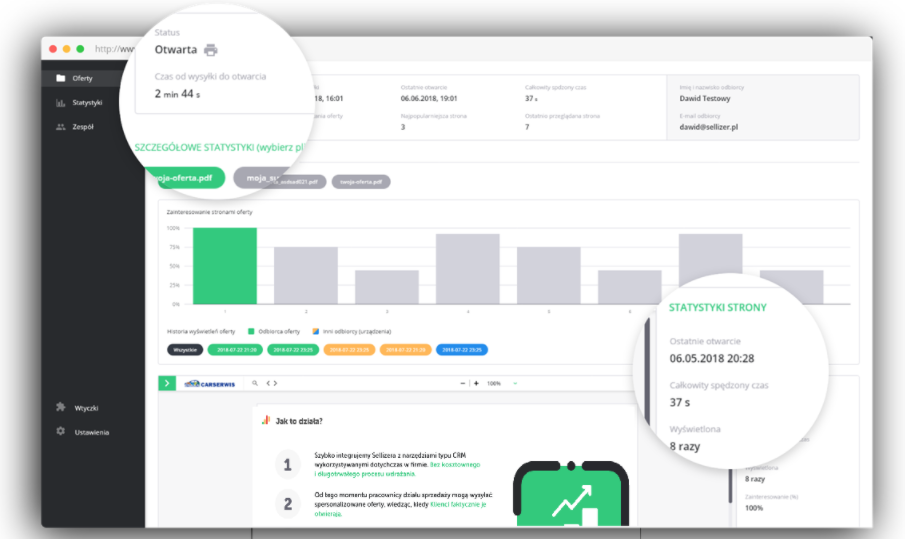
Conclusions from these statistics let you make better decisions and answer client needs more accurately.