



How B2B proposals are really read. Sellizer Report 2025

Almost everything about B2B selling has been written down - how to find clients, how to run a meeting, how to handle objections. But what happens to a proposal after you hit "send" is something few people know. No one has measured it precisely.
We decided to. We analysed how recipients actually read B2B proposals, using data from thousands of proposals sent through Sellizer in 2025: 50,768 proposal opens and 251,075 proposal views. We checked how many pages a sales proposal should have to be read to the end, how much time a client really gives it, which screen they open it on and how quickly after sending. No "best practices" and no opinions - just hard data on what recipients do with a proposal once they open it.
How many pages should a sales proposal have
You spend hours on a proposal. You pick the arguments, add slides, describe the company, references, guarantees. The question we rarely ask is: how much of it will the client actually read.
The answer depends on length. Up to roughly twelve pages, more than half of clients read the proposal to the end. Above that the share starts to fall clearly - at 13-20 pages only just 44% read the whole thing, and at 21 pages or more one in four clients.
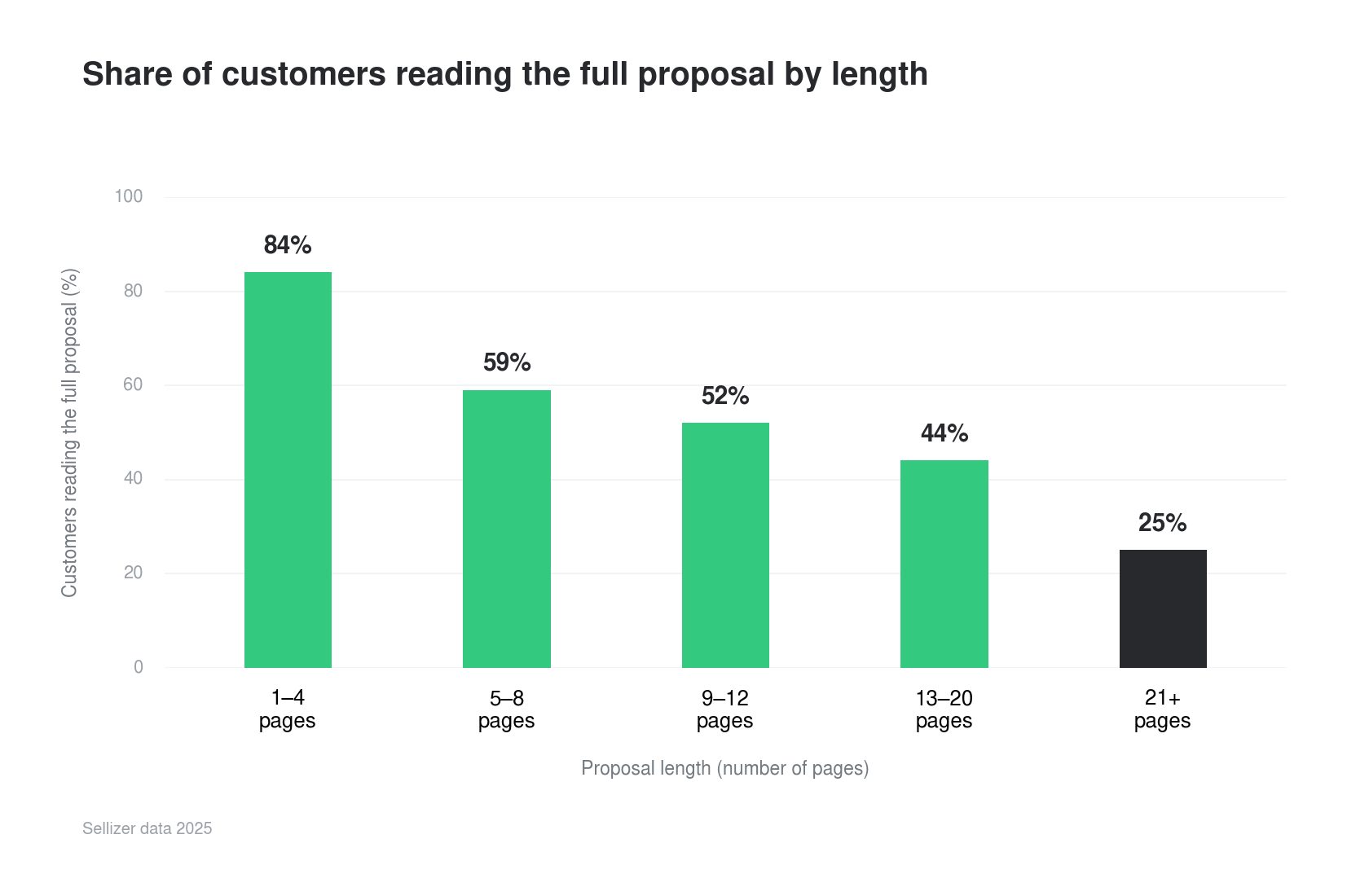
Intuition says more pages means more arguments, so it looks more solid. The data doesn't back that up. On a short proposal a client spends about a minute; on a much longer one, only about three. By adding pages above the threshold you spread the same amount of attention across more content. You don't get more of it.
| Proposal length | % of clients reading in full | Reading time |
|---|---|---|
| 1-4 pages | 84% | ~1 min |
| 5-8 pages | 59% | 2.3 min |
| 9-12 pages | 52% | 2.9 min |
| 13-20 pages | 44% | 3.3 min |
| 21+ pages | 25% | 3.1 min |
Sellizer data 2025.
One more thing we know about how proposals are read: 13% of clients don't even reach the halfway point of the proposal - regardless of how long it is. So you don't have the whole proposal to win the client over. Every page has to earn its place - bring something that genuinely interests the client, because the pages after it reach a smaller and smaller group. If you don't, you'll have put work into pages most clients will never see.
How much time you have before the client decides
You send the proposal and picture the client sitting down, reading paragraph by paragraph, weighing the arguments. The reality is different. The client doesn't read the proposal - they scan it.
A typical proposal view - a single visit to it - lasts about a minute. Only one in three views lasts longer than two minutes. It's a short window, not a calm read.
Long views are rare - only 7% run past ten minutes.
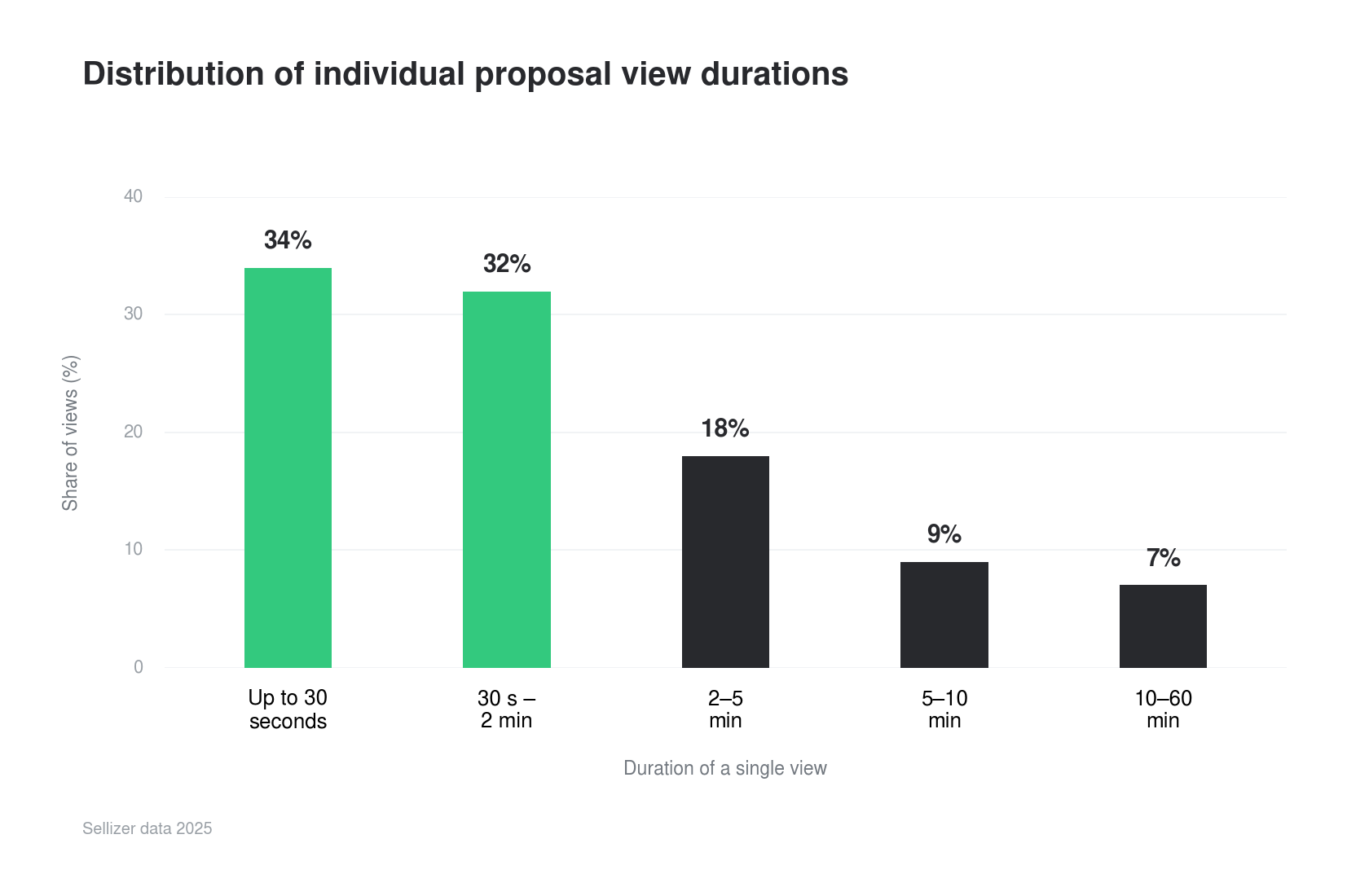
Worth adding that we measure real reading time, not an open tab - the clock runs only when there's activity on the proposal. That minute isn't inflated by abandoned tabs. That's what you really have.
Rarely the end of it, though: close to 65% of clients come back to the proposal at least once more. Adding up all the views, a single client spends over three minutes on the proposal. So we can infer that the decision rarely happens on the first pass - it matures between views.
The takeaway here is about the phone call, not the proposal. Since the client comes back, the second view is often the moment a question forms or a decision is made. A good follow-up isn't "just checking in on my proposal" - it's a call in reaction to the client having just looked at it again.
When the client opens the proposal and when to call
You send the proposal and wait for the right moment to call. One rep calls after an hour, another after three days - mostly on gut feeling. The data shows when the client actually reaches for the proposal.
Most clients open the proposal right away - 8 in 10 within the first day, and almost half within the first hour of sending.
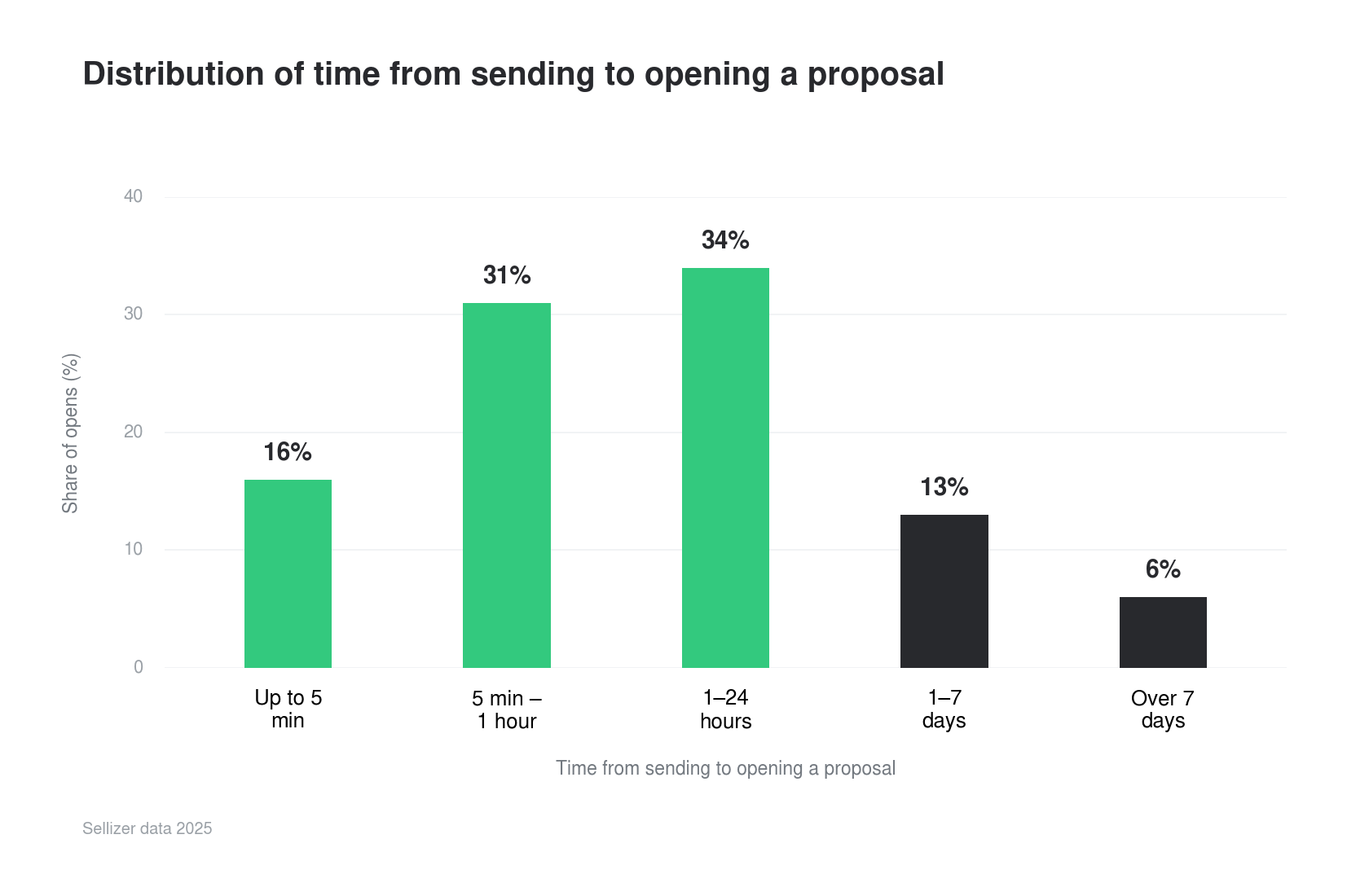
The moment of opening isn't predictable. One client opens the proposal after eleven minutes, another after fifteen hours. That's why a rigid "I'll call tomorrow" lands either on someone who is reading it right now or on someone who looked at it yesterday and has already moved on. Instead of calling by the clock from sending, it's worth reacting to the open - that's when the proposal is fresh for the client.
The first day isn't everything, though. Roughly one in five proposals is opened later - after a few days, sometimes a week. A client who went quiet didn't say "no". Sometimes they come back to the proposal a week later, because the topic resurfaced. So it's worth seeing those return visits - they're a signal to reach out, not a moment to give up.
Which device the client reads the proposal on
You build the proposal on a big screen. A PDF sized for A4, comfortable tables, full-width graphics. Except a sizeable share of clients open that proposal on a phone.
Nearly one in three proposals (30%) is read on a phone or tablet. On top of that, on a small screen the client reads for a shorter time - a typical view is 45 seconds, against 1 min 9 s on a computer.
| Device | Share | Typical view |
|---|---|---|
| Computer | 70% | 1 min 9 s |
| Phone | 29% | 45 s |
| Tablet | 0.3% | 1 min 33 s |
Sellizer data 2025.
The tablet is a margin - 0.3% of views. So the real choice is simple: computer or phone.
On a phone it's a quick scan between meetings, not a read. If the proposal is built only for a big screen, for nearly a third of clients it reads worse than you think. It's worth opening your own proposal on a phone before sending and seeing what happens to the small print and the tables - because that's where nearly one in three recipients lands.
Where this data comes from
All the figures come from the Sellizer platform and cover 2025. This is aggregated, anonymous data - we don't show any single proposal or client, only overall distributions.
The analysis covered hundreds of thousands of real events: over 50,000 proposal opens and over 250,000 proposal views (The same recipients often came back to them several times). We count only proposals that were opened - this report says nothing about how many recipients never opened a proposal at all.
We count time only when there's activity on the proposal - mouse movement, scrolling, clicking. When the client leaves an open tab and walks away, the clock stops. That way the figures show actual reading time, not a tab open in the background.