



Why You Can't Close Sales: 4 Proposal Mistakes

4 mistakes that lower the value of your proposal and minimize your chance of winning the client.
No contract is the result of an ill-conceived proposal, which in turn is the fault of a badly built relationship with the client. Which mistakes do salespeople make most often in the sales process, at the proposal stage - the ones that stop them from closing sales? We point them out and, more importantly, advise what to do to eliminate them once and for all.
1. I will prepare a competitive proposal for you.
What happens when you guarantee competitive solutions during a sales conversation? You are telling the potential client that you know the specifics of their business and understand the rules of their industry.
You imply that you know their needs, expectations and challenges so well that you do not even have to ask what a competitive proposal means to them.
You simply KNOW, and that is exactly what you will deliver.
Nonsense.
In reality, the knowledge you have about the client does not entitle you to give guarantees. Unfortunately, this mistake will be pointed out to you; the client will find at least a few points in your proposal that contradict your assurances of competitiveness. They will do it out of anger and... out of spite. That is human nature. If someone insists they know and understand us while actually knowing very little, we prove them wrong at the first opportunity.
2. I will describe everything in the proposal and send it over.
Everything, meaning: the essential specifics that influence the client's purchase decision - NOT EVERYTHING you have discussed with the client so far.
A good sales proposal is a clear summary of the key arrangements discussed with the potential buyer.
If it contains information about your company, only the facts that give them one more strong argument in favor of working together. It presents just a few selected solutions (products/services) with which your company will genuinely improve their business - and help reach their goals within the planned budget and deadline.
What decides a proposal's effectiveness? Your commitment to building the relationship with the client.
If during your meetings you talked more about the company you represent than you asked questions directly about the client, they simply do not believe your cooperation is meant to improve their business. They are aware you are trying to force something on them that they do not need at all.
If you care about mutual trust and healthy cooperation, you treat the client with respect - not condescension - and you prepare for every conversation. Mainly on the substance, but not only: skillful planning matters just as much.
Before the meeting, prepare an agenda and share it with the client.
After the meeting, send the client a clear summary of the arrangements so far.
A conversation plan gives you a sense of security (no fear of skipping an important thread) and control over the course of the conversation. No more dragged-out meetings. You do not need more time than you have to gather the valuable information necessary to prepare an effective sales proposal.
For the client, in turn, such documents are proof of your professionalism: excellent communication, reliability, credibility and transparency. That is why they are worth sending - preferably automatically, because formatting every single message sent to a client is an absurd chore that wastes precious time. Save it for other, more important tasks.
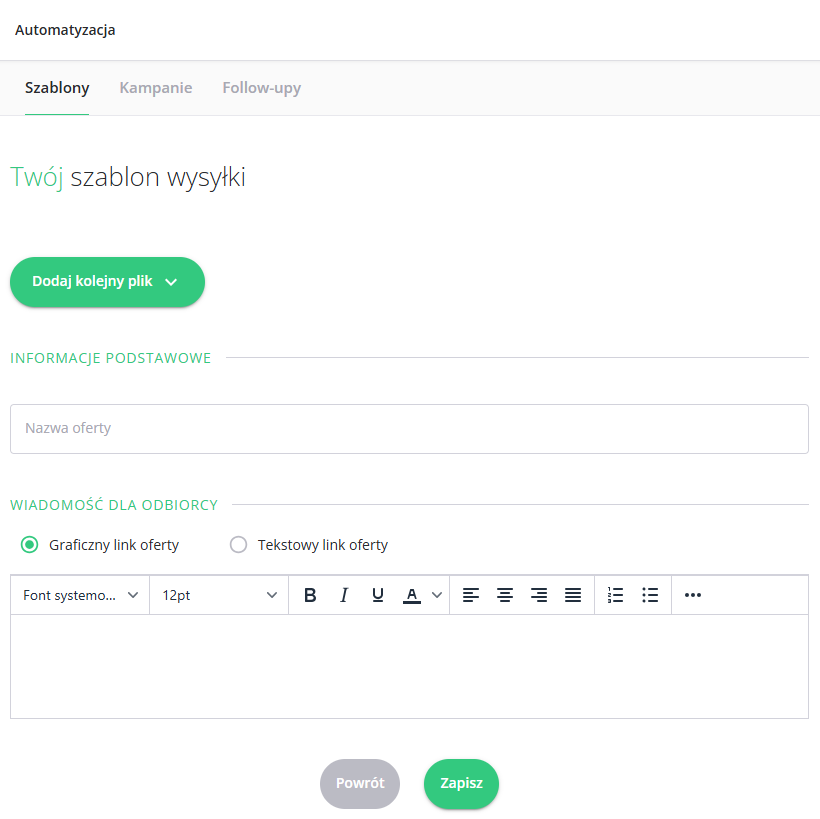
As a Sellizer user, you can implement your own ready-made templates (scenarios) for each type of message, available as a convenient list. At any moment you can pick the message template you need - an agenda, a summary, a first contact email and so on. 2 clicks and the email is ready!
3. Let's schedule a meeting where I will present our offer in detail.
A successful business conversation is one led by the salesperson - but the person who speaks the most is the client.
At the early stage of building your relationship, you cannot propose a meeting to present your proposal... because you do not have one yet. What is more, nobody expects it from you. This time, the first business meetings, belongs entirely to the client. Not to you.
Your task is a detailed analysis of the potential buyer's needs. In practice, that means asking plenty of the right - open-ended - questions and listening carefully to the answers.
Only this way will you gain reliable knowledge to treat as the foundation of a valuable sales proposal. About the condition of the potential client's business, their plans for the near and distant future, and the challenges standing between them and success (and what they even mean by that word).
In other words, you will find the direct sources of the potential client's purchase decisions and assign them to a specific category of needs (for example: prestige, comfort, efficiency, savings, security).
Only when you can name the client's expectations and the goal they pursue, and you understand what drives their purchase decisions and what problems their company struggles with, are you able to define the specific scope of cooperation.
You also know how to present the solutions (which features and benefits of the products/services to emphasize) to overcome possible objections and smoothly close the sale.
4. Have you had a chance to look at our proposal yet?
Here you make two mistakes at once.
First: You open the conversation with a closed question that kills the space for discussion: Have you... Use closed questions only as paraphrases - to confirm the client's answers to open-ended ones. This way you reassure them that you genuinely care about their situation and want to help them overcome the problems keeping their business stuck.
Second: You hand control of the sales process over to the potential client. You absolutely must not do that! Not only will they not let you take a step forward - after some time they will decide they are tired of conversations about nothing and demand you stop contacting them.
Conclusion: DO NOT send a proposal if you do not know whether, when and how the client reads it.
Contrary to appearances, this knowledge is no longer secret or hard to get. You can (and should!) gather it on an ongoing basis, in the form of clear and understandable data. All it takes is using Sellizer in your daily work - and knowing how to close a sale becomes a matter of reading the data:
no more asking "Have you read my proposal?" - you know the client has just opened it (you get an SMS notification from us) - learn more,
you do not wonder what happened to the proposal after it was opened (you know, among other things, how long the client viewed it and what they spent the most time on) - learn more,
you see what chances your proposal has with the client (you have access to reliable analytics with AI elements) - learn more,
you monitor live statistics describing the client's behavior and interactions with the proposal (refreshed every 5 seconds) - learn more.
FAQ
Why do deals stall after I send the proposal?
Usually because the proposal was sent blind: you do not know whether it was opened, which parts were read or when the client returned to it. Without that signal, follow-ups are guesses - either too pushy or too late. Tracking the proposal restores control: you call when the client is actually engaged.
How many follow-ups should I make before giving up?
Industry data says 80% of sales require about five contact attempts, while most sellers stop after one or two. Instead of a fixed number, follow engagement: a client who keeps reopening your proposal deserves more attempts than one who never opened it at all.
What is the single fastest way to improve my closing rate?
Timing. Contacting a prospect within minutes of them opening your proposal multiplies your chance of a substantive conversation - they are focused on your offer at that exact moment. It requires knowing about the opening, which is precisely what open notifications exist for.
Should I put the price in the proposal?
Yes. Hiding the price reads as a trick and forces an extra round of contact that many clients will not bother with. Clear pricing filters out price-only shoppers early and lets the ones who stay talk about value - a shorter, more honest path to a closed deal.